- Defend & Conquer
- Posts
- Aligning with CFO/COO: Making cyber risk a business risk, not just IT risk
Aligning with CFO/COO: Making cyber risk a business risk, not just IT risk
CybersecurityHQ Report - Pro Members

Daniel | CybersecurityHQ
24 Nov

Welcome reader to a 🔒 pro subscriber-only deep dive 🔒.
Brought to you by:
👣 Smallstep – Secures Wi-Fi, VPNs, ZTNA, SaaS and APIs with hardware-bound credentials powered by ACME Device Attestation
📊 LockThreat – AI-powered GRC that replaces legacy tools and unifies compliance, risk, audit and vendor management in one platform
Forwarded this email? Join 70,000 weekly readers by signing up now.
#OpenToWork? Try our AI Resume Builder to boost your chances of getting hired!
—
Get lifetime access to our deep dives, weekly cyber intel podcast report, premium content, AI Resume Builder, and more — all for just $799. Corporate plans are now available too.
Executive Summary
Your largest financial and operational exposure is already cyber-driven. The only question is whether your risk structure reflects that reality or hides it.
Revenue fragility is already higher than you admit. In most Fortune 100 environments, the top 10-15 revenue-generating processes depend on systems that cannot meet a four-hour recovery objective under realistic attack conditions¹. When those systems fail, you are not experiencing an IT outage. You are experiencing a liquidity and covenant risk event that belongs on the CFO's risk register, not the CIO's status report.
Core financial systems are being protected as legacy IT, not as sources of solvency. ERP, treasury, and consolidation platforms are often patched, tested, and taken down on cycles optimized for operational comfort, not for cyber exposure. For several large enterprises, shortening patch windows by even 20% eliminated entire classes of financially material fraud scenarios and removed auditor-flagged material weaknesses. CFOs need visibility into the trade-off between downtime and exploitable exposure, because only they own the covenant and rating consequences.
Supply chain risk now behaves like embedded leverage on your P&L. Third and fourth-party failures can stop production and distribution for weeks, with daily losses that exceed annual cyber insurance limits in a handful of days². The real risk is not the ransom number, it is the cumulative loss of throughput, working capital pressure, and lost market share. That is COO territory, and it is not being modeled explicitly today.
Identity is your new single point of business failure. Service accounts, machine identities, and privileged access patterns create direct paths from a single compromised credential to enterprise-wide disruption³. In multiple recent incidents, the limiting factor was not the exploit, it was the lack of clear ownership over identity risk between CISO, CIO, and COO. Until identity exposure is treated as a business continuity issue with quantified impact, you will continue to carry invisible, unpriced insolvency risk.
Board and executive liability is now tied to how you talk about cyber, not just how you control it. SEC, DORA, and NIS2 regimes have all moved from guidance to enforcement⁴. Misaligned statements about cyber maturity, risk appetite, and incident materiality now create personal exposure for directors and officers. If the board receives only qualitative heat maps and tool inventories, it cannot demonstrate due care when regulators or plaintiffs ask for evidence.
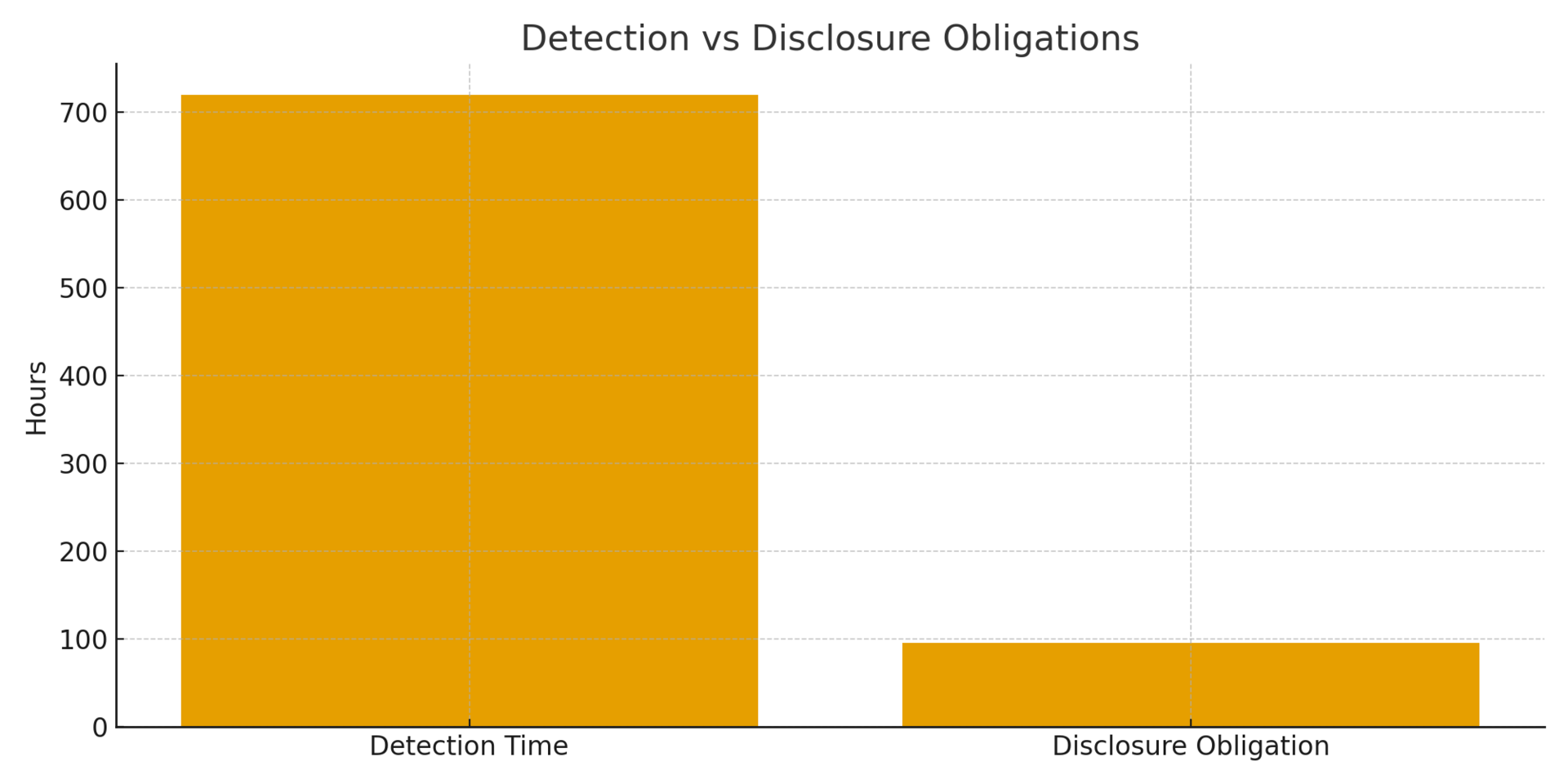
Your current detection and disclosure timelines are structurally incompatible. Average detection and containment timelines are still measured in months in many sectors, while disclosure obligations are measured in hours or days⁵. That gap is not just a technical metric. It is the window in which every investor communication, earnings call statement, and regulatory filing may become ammunition in a securities investigation.

Subscribe to CybersecurityHQ Newsletter to unlock the rest.
Become a paying subscriber of CybersecurityHQ Newsletter to get access to this post and other subscriber-only content.
Already a paying subscriber? Sign In.
A subscription gets you:
- • Access to Deep Dives and Premium Content
- • Access to AI Resume Builder
- • Access to the Archives
Reply